

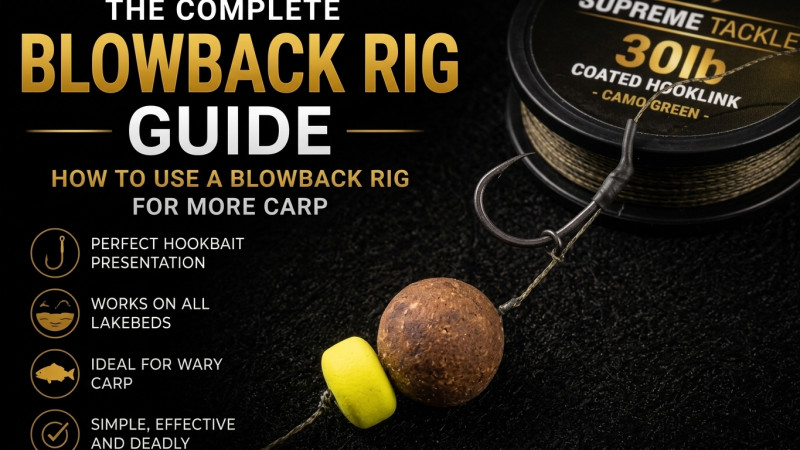
Blowback Rig Guide: How It Works, When to Use It and How to Tie It
The blowback rig is a proven carp fishing presentation designed to help the hookbait move independently of the hook. Its sliding ring arrangement allows the bait to shift along the hook shank when a carp tries to eject it, helping the hook remain free to turn and take hold.
In this guide, we explain how a blowback rig works, the components you need, how to set it up for bottom baits and wafters, and the situations in which it can be a useful choice. If you prefer ready-tied rigs, explore our ready made hair rigs and blowback rigs.
What Is a Blowback Rig?
A traditional hair rig attaches the bait beneath the hook, leaving the hook point exposed. A blowback rig adds a small ring on the hook shank, allowing the bait's hair to move relative to the hook.
When the fish mouths or blows out the bait, the ring can slide towards the eye rather than forcing the hook to follow the bait's movement.
This does not guarantee a hook-up. Hook pattern, hair length, bait size, rig material and how the carp feeds all influence performance.
How Does a Blowback Rig Work?
- The carp picks up the bait. The hookbait enters the mouth with the hook following on the hair.
- The hook has freedom to turn. The bait is not rigidly fixed to the hook shank.
- The ring can slide. During an attempted ejection, the bait may move while the hook remains better positioned to catch hold.
- The hook takes hold. Successful hooking depends on the mechanics, feeding angle and sharpness of the hook.
Components Needed for a Blowback Rig
- A sharp carp hook suited to your chosen hookbait.
- Coated braid or supple hooklink material.
- A small rig ring that slides freely along the hook shank.
- A hair loop, bait stop or appropriate hookbait attachment.
- Rig tubing or silicone where required.
- A suitable swivel or loop termination.
- A fish-safe lead arrangement.
There is no universally correct hook size or hooklink length. Match your components to the bait, lakebed, casting distance, weed and fishery rules.
How to Tie a Blowback Rig
- Prepare the hooklink. Cut a suitable length of coated braid. Strip a short section of coating if required.
- Create the hair. Tie a small loop or attach your preferred bait connector.
- Attach the rig ring. Secure the hair to the ring, allowing the ring to travel along the hook shank.
- Mount the hook. Position the ring and tie a neat knotless knot.
- Set the hair length. Ensure the hookbait cannot mask the hook point.
- Finish the hooklink. Add a secure loop or swivel and connect to a suitable lead arrangement.
- Test the rig. Check ring movement, hook sharpness, bait balance and freedom from tangles.
Best Hookbaits for Blowback Rigs
Bottom-Bait Boilies
Bottom baits are an excellent starting point for blowback rigs. The bait rests on the lakebed while the hook remains exposed. Adjust the hair length to avoid the bait crowding the hook.
Wafters
A balanced wafter can reduce the effective weight of the hookbait, making it easier for a feeding carp to inhale.
Test the exact hookbait and hook combination in water. A wafter that lifts the hook unnaturally may need rebalancing.
Explore our ready made wafter carp rigs for other presentations.
Pop-Ups
A standard blowback rig is not automatically the best choice for a buoyant pop-up. For raised presentations, a purpose-designed Ronnie Rig or Spinner Rig may be more appropriate.
When Should You Use a Blowback Rig?
Blowback rigs are particularly useful on reasonably clear fishing spots where the hookbait can settle naturally.
- Gravel: A good choice for bottom-bait presentations.
- Firm clay: Allows the rig to settle neatly.
- Light silt: Can work well with suitable hooklink material and lead arrangements.
- Clear spots in weed: Can be effective when the rig is presented cleanly.
- Heavy weed or deep soft silt: May require a different presentation.
Blowback rigs can be used throughout spring, summer, autumn and winter. Location, fish behaviour and bait choice are more important than the season alone.
Common Blowback Rig Mistakes
- Restricted ring movement: The ring should slide as intended without jamming.
- Hair too short: A bait pressed against the hook can restrict movement.
- Hair too long: Excessive separation can cause tangles.
- Blunt hooks: Check the hook point regularly.
- Poor bait balance: Test wafters and buoyant hookbaits before casting.
- Wrong lakebed: Avoid presenting a straightforward bottom-bait rig where it is likely to become buried.
Blowback Rig vs Standard Hair Rig
Both rigs separate the hookbait from the hook, leaving the hook point exposed.
The main difference is the sliding ring on the blowback rig, which gives the bait additional movement along the hook shank.
A standard hair rig is simpler and remains highly effective. A blowback rig provides an alternative presentation rather than a guaranteed improvement in catch rates.
Blowback Rig FAQs
Are blowback rigs good for bottom baits?
Yes. Blowback rigs are commonly used with bottom-bait boilies and other sinking hookbaits on clear, fishable lakebeds.
Can I use a wafter on a blowback rig?
Yes. Ensure the hookbait is balanced correctly and the hook point remains exposed. Test the setup in water before casting.
What hook pattern is best for a blowback rig?
Several carp hook patterns can work. Choose a sharp hook with a suitable gape, size and eye angle for your bait and hooklink.
Can a blowback rig be used over silt?
Yes, particularly over firm or light silt. Very soft silt may require a different hooklink arrangement to prevent the hookbait becoming buried.
How long should a blowback rig be?
There is no universal length. Shorter hooklinks can suit accurate feeding on clear spots, while other conditions may require longer or more supple arrangements.
Is a blowback rig better than a hair rig?
Neither is automatically better. Blowback rigs offer additional bait movement, while standard hair rigs are simpler. Both can catch carp when presented correctly.